Or Why Mimicry of Industry Giants Should Be Considered Harmful
Zen Buddhism is taught through a series of paradoxical statements, or koans. Meditating on these koans helps pull the student out of conventional thinking and into a deeper understanding of Zen and conventional reality.
One of my favorite Zen koans goes like this:
If you meet the Buddha on the road, you must kill him.
Linji Yixuan
What does it mean?
At my work, we are creating a new kind of SaaS platform. This platform is something the world has never seen before, so we don’t know exactly what it will look like. We have some great ideas based on 15 years in the location business, but we are still exploring. We are searching for Product Market Fit.
Searching for success, it is common for companies at our size to emulate what seem like “best practices” used at industry giants like Google, Facebook, Amazon, and Microsoft.
I understand the desire to emulate the best, but this is a dangerous game. When initiatives are justified by “that’s how we did it at Microsoft/Google/et al,” this isn’t the flex you think it is.
In fact, we should view the patterns and practices of industry giants with great skepticism.
What’s so magnificent about the Magnificent Seven?

The original Magnificent Seven (1960) is a Western film based on Akira Kurasawa’s classic Seven Samurai. It starred Yul Brynner, Steve McQueen, Charles Bronson, and James Coburn, all before they became big Hollywood stars. Later there was a TV show and a 2016 remake.
It’s a story about how a small village hires seven gunfighters to protect them against a gang of bandits. The gunfighters teach the villagers how to defend themselves, and by the end of the movie, 70 people are dead (including four of the seven).
But I digress. We aren’t interested in that Magnificent Seven. We are talking about this one:
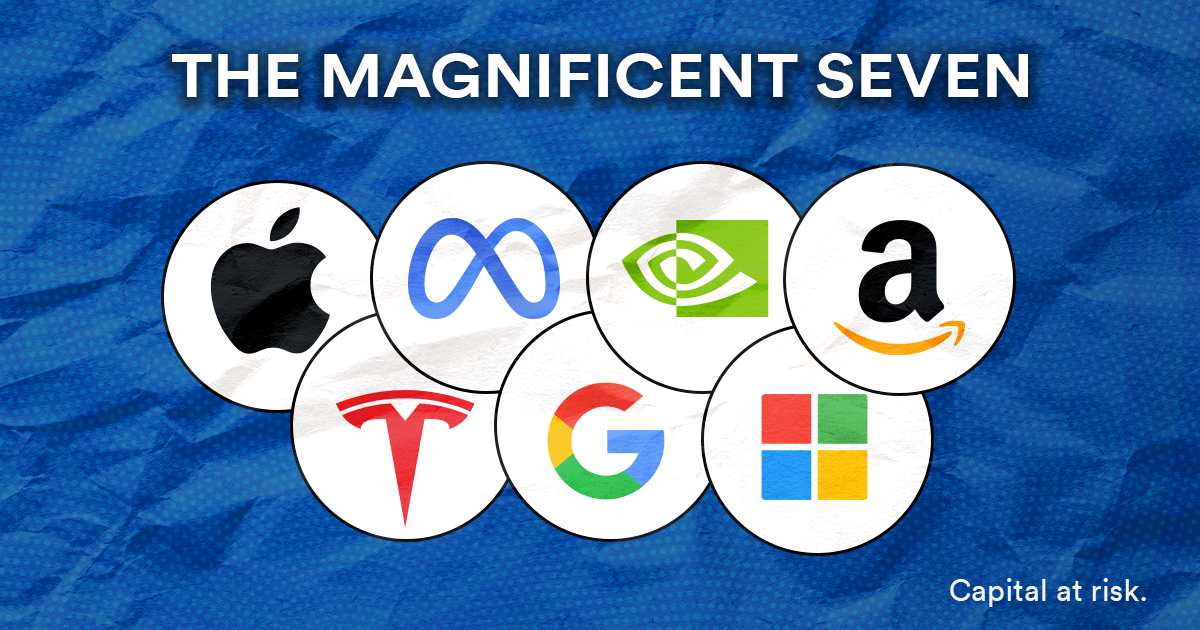
Apple, Tesla, Meta, Google, Nvidia, Microsoft, and Amazon.
What’s special about these companies? The Magnificent Seven are each lucky to have found a money-printing machine. Google’s advertising business generates $240 billion annually. Facebook’s advertising business has $130 billion in revenue. Microsoft’s Windows and Office units clock in at more than $70 billion per year. Amazon generates $30 billion of free cash flow, primarily from retail operations and AWS. The iPhone business unit makes $200 billion for Apple. These businesses are the ultimate examples of Product Market Fit at scale.
With billions in profits, Google gleefully firehoses money into questionable investments like internet broadcasting hot air balloons and extravagant perks like 20% time. Facebook has spent over $35 billion on the Metaverse. Apple recently abandoned an expensive automotive product.
Additionally, these companies have many peculiar technology practices. Facebook has created its own programming language (Hack) to make a lousy programming language (PHP) safer. The overwhelming majority of Google products are stored in a single Perforce repo.
Therein lies the problem. When a company sits atop a money printing machine, virtually any organizational structure or technical practice will work. Any financial investment seems like a good idea. A few billion dollars will iron out a lot of wrinkles.
When Statisticians Save Lives
Let’s take a brief diversion into the history of statistics. Story time!
During World War II, the Navy was losing a lot of B17 bombers. Military analysts carefully studied returning aircraft and found a notable pattern in the distribution of bullet holes.

The answer here seemed quite obvious. Clearly, we should add more armor in the places where planes are getting shot!
Fortunately for the crews on future B17 flights, a statistician named Abraham Wald was able to prove mathematically that this approach was the opposite of what they should do. Because the airplanes analyzed were the ones that made it home, these damage patterns indicate all of the places a B17 can get shot and still survive. Shells that hit planes that didn’t come home in the unmarked areas caused them to crash.
Survivorship bias is a form of selection bias that can lead to overly optimistic beliefs because multiple failures are overlooked, such as when companies that no longer exist are excluded from analyses of financial performance. It can also lead to the false belief that the successes in a group have some special property, rather than just coincidence as in correlation “proves” causality.
https://en.wikipedia.org/wiki/Survivorship_bias
Applying this metaphor to Tech Startups, only a few innovations matter to company success (such as AdWords, iPhone, MS Office). These are similar to the engines, cockpit, and tail of a B17. If these critical areas can be protected, the rest of the business could actively destroy shareholder value, and the planes would still return home safely.

The lesson here is simple. We must not blindly adopt patterns and practices used by industry leaders.
Which brings us back to the title of this post.
If you meet the Buddha on the Road, Kill Him
What does it mean? I’m not a Buddhist scholar, so I’m going to borrow words from someone more eloquent than I (emphasis added):
There are often points in our practice journey where we need to seek advice and experience from those further along the path. But within the teacher/student relationship can arise a point at which the student is susceptible to idolizing their teacher and thus forgoes their own growth …
Idolizing a teacher is one side of the dilemma. The other lies in the teachings themself. Over the life of our spiritual practice, there may be times when we begin to conceptualize the nonconceptual. We begin to “know” rather than remain open to. When we cling strongly to what we have learned, it becomes easy for us to be convinced that we get it, and in fear of losing it, we begin to hold tightly to it. This fixation ends up becoming a crutch towards our growth. The teacher and teachings are both useful and to some degree, necessary, so they should be utilized, but both also must, ultimately, be allowed to drop away. For one to truly grow in spiritual practice we must let go. Let go of all concepts and remain in an attitude of openness, eagerness, and without preconceptions. A state known, among Zen practitioners, as “beginner’s mind.”
Killing the Buddha means killing our conceptualizations, killing the belief that we understand it all.
– Lion’s Roar
The Beginner’s Mind
How do we identify which patterns and practices are worth emulating?
What made these companies so successful?
The Google story seems simple:
- Create a step function improvement in search results quality.
- Copy a competitor delivering a new kind of advertising (Overture’s PPC) to a much smaller user base.
- Use excess profits to create monopoly market share in search and then protect it.
- Buy traffic from industry partners like Firefox and Apple
- Acquire compatible competitors like YouTube and Doubleclick
Unfortunately, the first item on the list is quite difficult to emulate!
Let’s examine at Facebook next:
- Dominate the social media market for universities with a more user-friendly, more addictive social network.
- Expand dominant share in education into the larger market for all social networks.
- Sell advertising to a large mobile market assembled from a mix of first-party applications (Facebook, Messenger) and platforms (Facebook Login, Advertising Platform).
Similarly, if we could have invented PageRank or TheFacebook, we would have done it already.
Revolutionizing an entire industry is a mixture of hard work, smarts, “right place, right time,” and a lot of luck.
What are the specific patterns or cultural elements that enabled these key innovations?
To be honest, we’ll never know for sure unless we were one of the first few hundred employees at one of these companies. Most of the people who experienced these revolutions first hand are unlikely to be reading this article while enjoying early retirement on their private jet.
Each of these companies has a certain reputation which may causally explain their success (but really, we will never know for sure):
- Microsoft – controlled their own distribution with a combination of ruthless deal making and luck.
- Apple – consistently delivered a better experience by mixing together off-the-shelf technology with one or two key innovations, and holding these new products to much higher usability standards than competitors.
- Amazon – maniacal customer focus coupled with the best cash flow management in the industry.
- Google – early focus on speed and quality.
- Facebook – relentless focus on the user experience and culture of experimentation.
Are these practices worth emulating? Maybe!
Also, maybe not. When deciding whether to emulate a specific practice, you must think critically about whether your company is a good match for this pattern.
- Company Lifecycle – are you still trying to find Product Market Fit? Don’t copy Google’s famous 2007 experiment to pick a shade of blue – when Google had $16 billion in revenue. Instead, consider how Dropbox acquired their first 100 users.
- Size – If your company has 250 employees, don’t adopt an organizational structure that helped Microsoft scale to 200,000 employees. Instead investigate how Figma pulled a $10 billion valuation with just 500 employees.


 Blog of Yount Labs
Leave a reply to marshally Cancel reply